
Consistency, efficiency and aesthetics are no longer trade-offs in modern dentistry, they’re expected outcomes.
For dental laboratories, dental prosthetists and clinicians, delivering reliable dental restorations depends on more than individual materials. It requires a coordinated approach across dental ceramics, CAD/CAM, zirconia systems and prosthetic workflows.
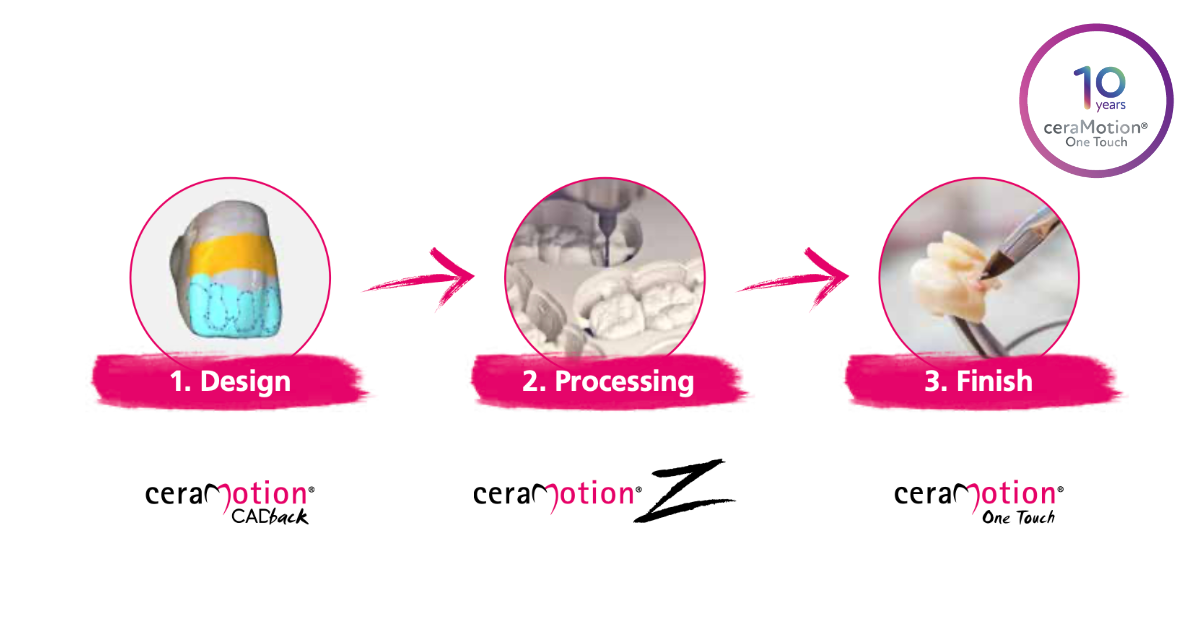
As Dentaurum celebrates 10 years of ceraMotion® One Touch, it highlights how a well-designed system, supported by the broader ceraMotion® workflow can deliver predictable results while enabling labs to standardise and scale production.
10 Years of ceraMotion® One Touch
In 2016, Dentaurum launched ceraMotion® One Touch as the first veneering ceramic in paste form, introducing a more efficient and simplified approach to finishing all-ceramic restorations.
While many similar products have since entered the market, ceraMotion® One Touch remains the original. Its 2D and 3D ceramic pastes, specifically developed for pink and white aesthetics, continue to be widely used in laboratories for restorations made from lithium disilicate and zirconium oxide.
Today, these pastes remain a preferred solution for technicians, supporting efficient workflows while consistently delivering natural aesthetic outcomes.
The ceraMotion® Workflow: From Design to Finalisation
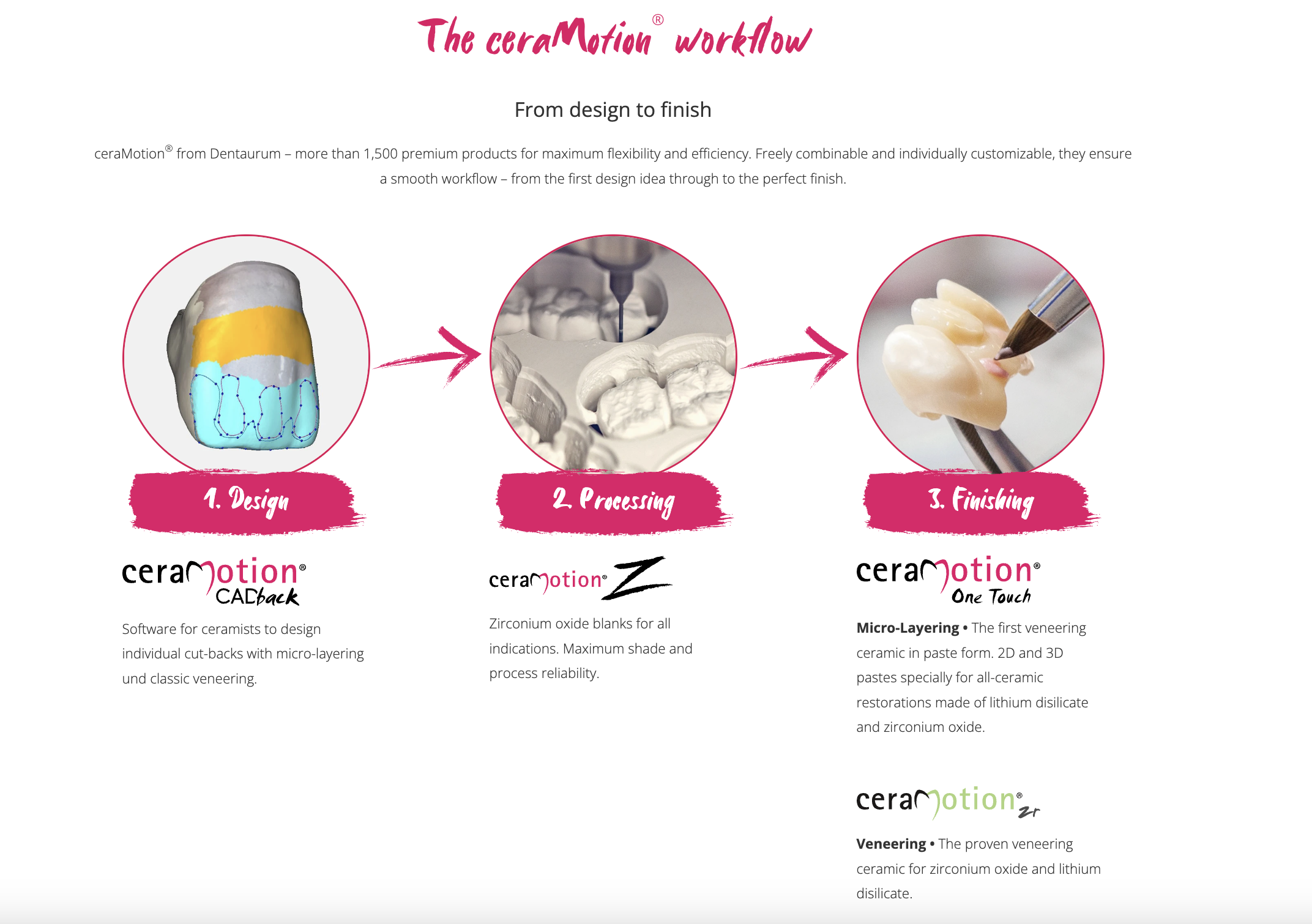
By connecting design, processing and finishing into a unified system, ceraMotion® delivers consistency across every stage of the workflow.
For laboratories this means:
- Standardised workflows that reduce rework
- Materials that behave predictably not independently
- Scalable processes that support growth without compromising quality
For clinicians:
- Reliable, repeatable outcomes across every case
- Confidence in both fit and aesthetics
- Faster turnaround from lab to chair.
From initial design through to final finishing, each stage is built around a core advantage: every material is designed to work together as part of a single, coordinated system, reducing variability and absolute predictability.
1. Design: Digital Control from the Start
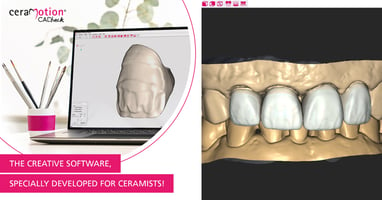
Using CAD/CAM systems and tools such as ceraMotion® CADback, technicians can design restorations with precision and consistency. ceraMotion® CADback is developed specifically to align with Dentaurum materials. This ensures that digital design decisions translate directly into predictable physical results, reducing the disconnect between planning, milling and finishing.
For laboratories:
- This means greater control over morphology based on real material behaviour
- Standardised design protocols aligned with downstream processing
- Reduced remakes through improved digital-to-physical accuracy
For clinicians:
- Predictable outcomes from the planning stage
- Clearer communication between lab and clinic
- Better alignment between design intent and final restoration
- A great outcome for the patient
2. Processing: Reliable Zirconia Performance
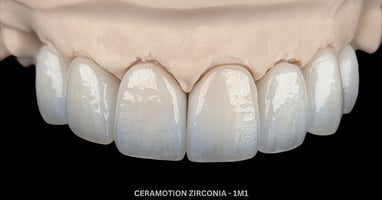
The processing stage is underpinned by ceraMotion® Z zirconia blanks delivering consistency through milling and sintering.
Explore the many benefits of zirconia from labs that are using it:
Dentaurum zirconia is developed within the ceraMotion® system, meaning shade stability, translucency and processing behaviour are consistent across batches and aligned with finishing materials. This system compatibility reduces variability often seen when mixing suppliers or materials.
For laboratories:
- Reliable results across zirconia CAD/CAM workflows
- Consistent shade and translucency across cases
- Greater confidence during milling, sintering and finishing
For clinicians:
- Consistent fit and marginal integrity
- High-strength materials for long-term performance
- Predictable aesthetics in zirconia crowns and bridges
3. Finishing: Efficient Micro-Layering with ceraMotion®One Touch
ceraMotion® One Touch simplifies the finishing stage through ready-to-use 2D and 3D ceramic pastes.
Unlike traditional veneering systems, ceraMotion® One Touch is engineered to work seamlessly with zirconia and lithium disilicate materials, enabling minimal-layer micro-layering with repeatable, controlled results.
For laboratories:
- Faster finishing with fewer steps than conventional layering
- Consistent paste handling, reducing technique sensitivity
- Greater control over surface detail without adding complexity
For clinicians:
- Natural aesthetic outcomes with reliable consistency
- Improved shade integration with surrounding dentition
- Reduced chairside adjustments due to predictable finishing
Supporting Natural Aesthetic Outcomes
ceraMotion® materials are designed to support the demands of modern aesthetic dentistry, enabling:
- Natural translucency and depth
- Fluorescence aligned with natural dentition
- Controlled opalescence for realistic shading
These characteristics are essential for producing natural ceramic restorations that integrate seamlessly with surrounding teeth.
Learn more:
10 Years On: A Proven Workflow for Modern Labs
Ten years on, ceraMotion® One Touch continues to support laboratories with a practical, efficient approach to finishing.
Combined with the broader ceraMotion® workflows including CAD/CAM tools, zirconia systems and coordinated ceramic materials, it enables laboratories to deliver consistent, high-quality results across every case.
Explore the milestone:
10 Years of ceraMotion® One Touch
Supporting Labs, Prosthetists and Clinics
For Dental Laboratories
- Streamlined workflows across ceramics and CAD/CAM
- Efficient production of zirconia crowns and dental restorations
- Improved consistency across technicians and cases
For Dental Prosthetists and Clinicians
- Reliable outcomes across crown and bridge work
- Consistent fit, function and aesthetics
- Confidence in long-term restoration performance
About Dentaurum
Dentaurum is a global manufacturer specialising in orthodontics, dental prosthetics and ceramics. With 140 years of experience in materials for prosthetics, dental ceramics and digital dentistry, Dentaurum continues to develop systems that support both laboratory efficiency and clinical outcomes.