


Skeletal anchoring according to the Pin-Last© concept. Palatal expansion represents a specialised...
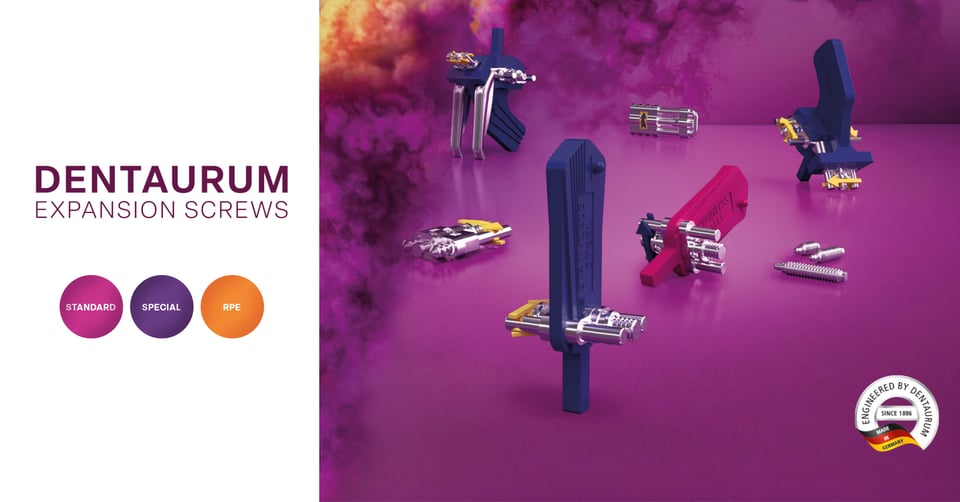
An expansion screw is one of the smallest components in an orthodontic appliance, but the choice of screw can have a significant influence on how that appliance is designed, fabricated and activated.
For clinicians, the starting point is the treatment objective. For the laboratory, it is about translating that prescription into an appliance with the right mechanics, materials and components.
That is why there is not simply one expansion screw. From a straightforward removable expansion plate to a more complex functional appliance requiring movement in several directions, different clinical situations call for different designs.
Expansion screws have formed part of Dentaurum's orthodontic portfolio for decades, with today's range spanning Standard, Special and rapid palatal expansion solutions. The screws are developed and manufactured at Dentaurum's facility in Ispringen, Germany, combining long-standing orthodontic expertise with precision manufacturing.
It starts with the appliance, not the screw
The decision to use expansion, and the type of movement required, starts with clinical assessment and treatment planning.
Where expansion is clinically indicated, the laboratory needs to translate those clinical requirements into an appliance designed to deliver the prescribed movement.
A traditional expansion plate may require relatively straightforward controlled expansion. Another appliance might need to move a particular section independently. Others may require transverse expansion alongside sagittal movement, or form part of a functional orthodontic approach.
The mechanics required from the screw change accordingly. This is where the distinction between Standard and Special expansion screws becomes particularly useful.
Standard expansion screws: the workhorse of removable appliances
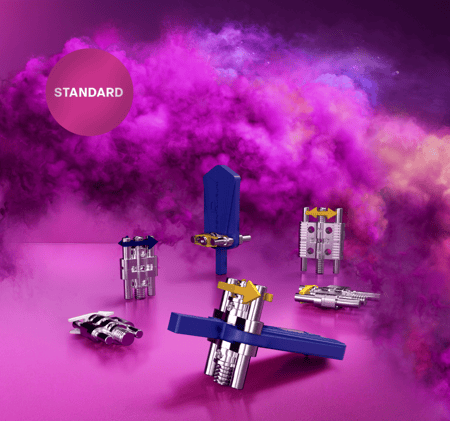
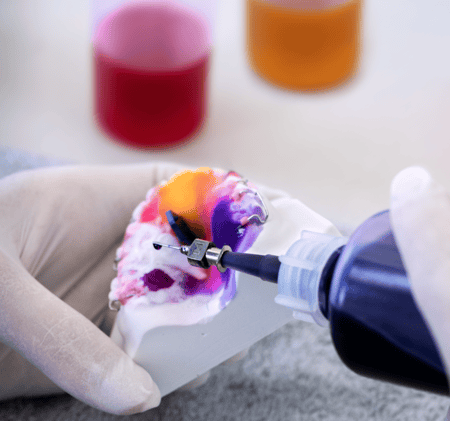
Standard expansion screws are widely used in removable orthodontic appliances, including individual expansion plates such as the classic Schwarz plate. Dentaurum's Standard range provides different sizes, holder designs and expansion capacities, allowing the component to be selected according to the appliance and the prescribed movement.
Where the treatment prescription calls for controlled expansion through a removable appliance, the laboratory can select a screw with dimensions and expansion capacity appropriate to the appliance being constructed.
But simple should not mean imprecise. The screw needs to open consistently when activated, remain stable as expansion progresses and integrate securely into the acrylic. It also needs to be practical for the technician to position and process during fabrication.
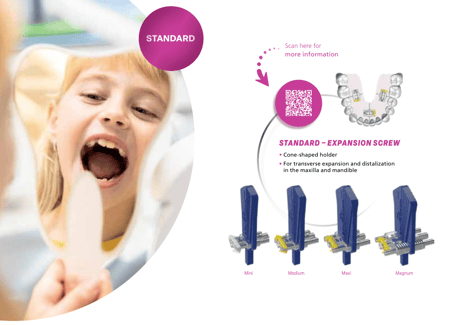
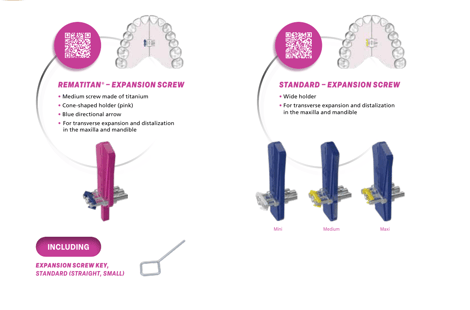
Standard expansion screws at a glance
-
Options in Mini, Medium, Maxi and Magnum sizes, depending on the holder design.
-
Cone-shaped and wide-holder configurations for different appliance requirements.
-
Applications including transverse expansion and distalisation in the maxilla and mandible.
-
Precise, reproducible activation to support controlled expansion.
-
Strong retention in acrylic and practical laboratory processing.
-
A rematitan® medium titanium option with a cone-shaped pink holder and blue directional arrow.
The important point for clinics and laboratories is choice. Rather than designing an appliance around the limitations of a single screw, the component can be chosen to suit the appliance, available space and prescribed movement.
Special expansion screws: when the required movement becomes more complex
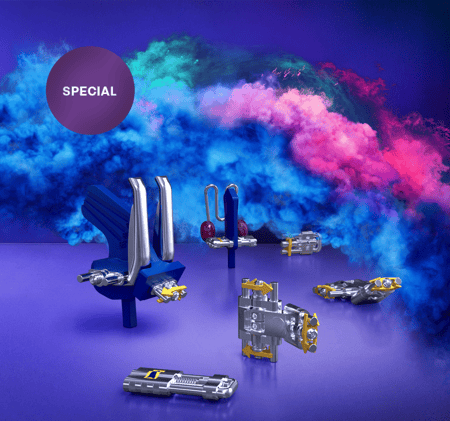
Not every appliance can achieve its intended purpose with a conventional expansion screw.
There may be a need to move an individual tooth or section, create differential movement or incorporate several directions of movement into a functional appliance. That is where Dentaurum's Special expansion screws become particularly relevant.
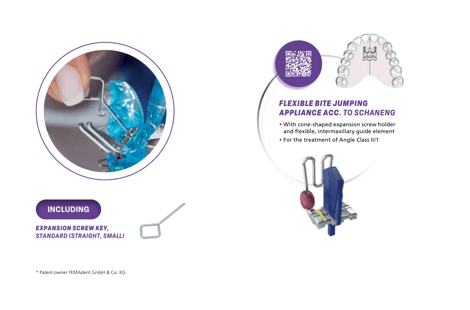
Rather than simply being variations on a Standard screw, these components have mechanics designed around specific movements and appliance concepts. The wider Special portfolio includes sectional and retraction screws, fan-type screws and three-dimensional screws, as well as screws developed for particular functional orthodontic applications.
For the laboratory, that creates greater flexibility when translating the clinician's prescription into a custom appliance. The benefit is not simply having more products available. It is having different mechanics available when the appliance itself needs to do something different.
Special expansion screws at a glance
-
Solutions for more complex indications when conventional screw mechanics do not suit the appliance design.
-
Indication-specific movement options rather than a one-size-fits-all approach.
-
Greater flexibility for custom and functional appliance design.
-
Options for multi-directional movement with selected designs.
-
Designs informed by Dentaurum orthodontic experience and collaboration with orthodontic experts.
When one direction of movement is not enough
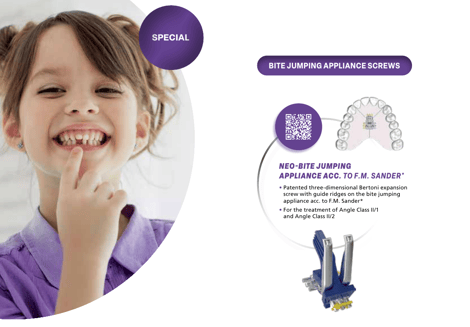
Some of the more interesting examples within the Special range are the three-dimensional screws.
Designs according to Steiner and Bertoni, together with Neo-Bertoni options, enable two or three independently controlled movements depending on the selected screw. This can make combined transverse and protrusion movement possible within Y-plate designs.
From a treatment-planning perspective, the important point is not the engineering for its own sake. It is the ability to build an appliance around the movement required, rather than compromising the intended appliance design around the limitations of a generic component.
The clinician needs to communicate what the appliance is intended to achieve. The technician needs to understand those objectives well enough to choose and incorporate components with appropriate mechanics.
Small details that make a practical difference
Whether Standard or Special, some of the most useful features of an expansion screw are not necessarily the ones that immediately attract attention.
Dentaurum incorporates a brake hole into the screw design to increase friction within the thread system. This helps prevent the screw from reversing unintentionally following activation.
The screws are designed to open evenly while maintaining stability during activation. An expansion stop prevents the individual components from separating at the end of the available expansion path.
A visible activation point makes the key receptacle easier to identify, while a directional arrow makes the intended direction of activation clear. For laboratories, screw holders assist with positioning and alignment on the model before processing, while the skeletal screw design allows acrylic to surround the component for secure retention.
|
What this means in practice For clinics: controlled activation, clear activation direction, stable function and dependable mechanics within the completed appliance. For laboratories: straightforward model positioning, efficient incorporation into acrylic, secure retention and a choice of mechanics suited to the prescription. |
Dentaurum RPE Screws: Precision for Palatal Expansion
Completing Dentaurum’s expansion screw range are its rapid palatal expansion (RPE) screws, offering clinics and laboratories a proven solution for controlled and predictable palatal expansion.
Dentaurum’s RPE screw range is designed to provide precise, controlled and reliable palatal expansion, with options suited to tooth-borne, hybrid and skeletal appliances, including MARPE. The range includes the proven Hyrax®, Hyrax® Click, which provides audible and tactile feedback after each quarter-turn to support controlled activation, and the Titan Hyrax®, a lightweight titanium option offering high biocompatibility and mechanical strength. Across the range, features such as stable guidance, reinforced construction, clear activation markings and integrated safety stops help support predictable appliance performance, while different sizes and configurations give clinicians and laboratories flexibility across conventional and digitally designed workflows.
Engineered and made in Germany
The reliability of a precision component also depends on how it is made.
Dentaurum expansion screws are developed and manufactured at the company's facility in Ispringen in Germany's northern Black Forest. High-quality stainless steel is combined with modern manufacturing technologies and precision production processes.
Strict quality controls and final inspections support the dimensional accuracy and consistency required from a component designed to be repeatedly activated during appliance use.
From prescription to custom appliance
Perhaps the most interesting part of the expansion story is the interaction between clinical thinking and laboratory expertise.
Dr David Buck has specialist appliances made by Enrico DiGiovanni at A Point Dental Lab using Dentaurum expansion screws. It is a useful illustration of the process.
Dr David Buck identifies the treatment requirements. Enrico considers how those objectives can be translated into a physical appliance, including the movements required, the position and orientation of components and the materials used in its construction.
The expansion screw is selected because it suits the appliance design, rather than the appliance being designed simply to accommodate a particular screw.
For growing patients, this can include custom appliances intended to address transverse discrepancies and support maxillary development where clinically indicated.
This makes communication between clinic and laboratory particularly important. The more clearly the intended movement and treatment objective are communicated, the better equipped the technician is to select suitable mechanics and design the appliance accordingly.
Building the rest of the appliance
Choosing the appropriate screw is only one part of fabricating a removable appliance.
Technicians also need to consider the acrylic, wire components, clasps, springs and how all those elements interact in the finished design.
Dentaurum's removable appliance portfolio reflects this broader workflow. Alongside expansion screws, it includes Orthocryl® acrylic, orthodontic wires, labial bows, retention clasps and active spring elements.
For the lab, it is a useful reminder that a custom appliance is not defined by one component. It is the interaction between the prescription, appliance design, screw mechanics, wire elements and acrylic construction that creates the finished appliance.
And this is where growth enters the conversation
While the technician is concerned with how to translate a prescription into an appliance, the clinician first needs to determine whether intervention is appropriate and what treatment is intended to achieve.
That becomes particularly relevant in growing patients. Treatment planning may involve looking beyond individual tooth position to consider transverse discrepancies, jaw development, function, growth and timing.
Expansion appliances can form part of that picture where clinically indicated, but they are not the whole story.
It is this wider perspective that connects the expansion screw range with Dentaurum's Growth Window – Beyond Straight Teeth course with Dr David Buck.
The course provides an opportunity to step back from individual appliances and consider the broader principles around growth, jaw development, function and early orthodontic intervention.
For clinicians, that means considering why and when to intervene. For laboratories, understanding the thinking behind the prescription provides valuable context when translating treatment requirements into individual appliance designs.
Between the two sits the appliance itself: the point where clinical planning, technical expertise and precision components come together.
Go beyond straight teeth
Dentaurum's support for orthodontics extends beyond products into continuing education, including practical seminars around expansion screws and removable appliance techniques.
The Growth Window – Beyond Straight Teeth with Dr David Buck continues that conversation, exploring early orthodontic treatment through the wider lens of growth, development and function.

You can join Dr David Buck for a practical, two-day clinical course exploring the connection between airway, growth and function in early orthodontic treatment.
Discover how to recognise developmental concerns, assess paediatric sleep and airway factors, and make informed decisions about early orthodontic intervention through hands-on workshops and clinical case studies.
2–3 April 2027
InterContinental Sydney
14 CPD Hours
Early Bird: $2,246 + GST (limited places)

